

Hiring has always been a human business. A manager needs someone who can solve a real problem. A candidate wants a role where their skills, ambition, and life fit together. Somewhere between those two needs sits the talent acquisition team, trying to move quickly without making expensive mistakes.
That job has become harder.
Enterprise hiring teams are dealing with skill shortages, leaner budgets, overloaded recruiters, faster-changing technology roles, and candidates who are also using AI to apply, prepare, and negotiate. The old hiring funnel was not built for this kind of pressure. It was built for resumes, keywords, job boards, and manual review.
AI in talent acquisition is not a magic fix. Used poorly, it can add noise, bias, and confusion. Used well, it gives hiring teams a sharper view of talent, skills, timing, and fit. The real opportunity is not replacing recruiters. It is helping them spend less time digging through data and more time making better decisions.
Why AI Has Become a Talent Acquisition Priority
A few years ago, AI in recruiting was mostly treated as an efficiency tool. It could screen resumes, schedule interviews, or write job descriptions. Useful, but limited.
Now the conversation is bigger. HR leaders are asking better questions:
Can we identify skills before competitors do? Can we build talent pipelines before a role opens? Can we see where hiring delays are really happening? Can we match candidates to outcomes, not just job titles?
That shift matters because enterprise hiring is no longer just about filling seats. It is about workforce readiness. When a company needs cloud engineers, cybersecurity analysts, healthcare professionals, finance specialists, or AI-skilled developers, the cost of delay can show up in missed revenue, project slippage, customer churn, and burnout inside existing teams.
AI helps by turning scattered recruiting activity into usable intelligence. It can analyze job requirements, candidate skills, market availability, compensation signals, and historical hiring patterns at a scale no human team can manage manually.
But the strongest results come when AI supports a clear talent acquisition strategy, not when it becomes the strategy.
From Keyword Matching to Skills-Based Hiring
Traditional recruiting systems often rely too heavily on keywords. If a resume includes the right tool, title, or certification, the candidate moves forward. If not, they may disappear from view.
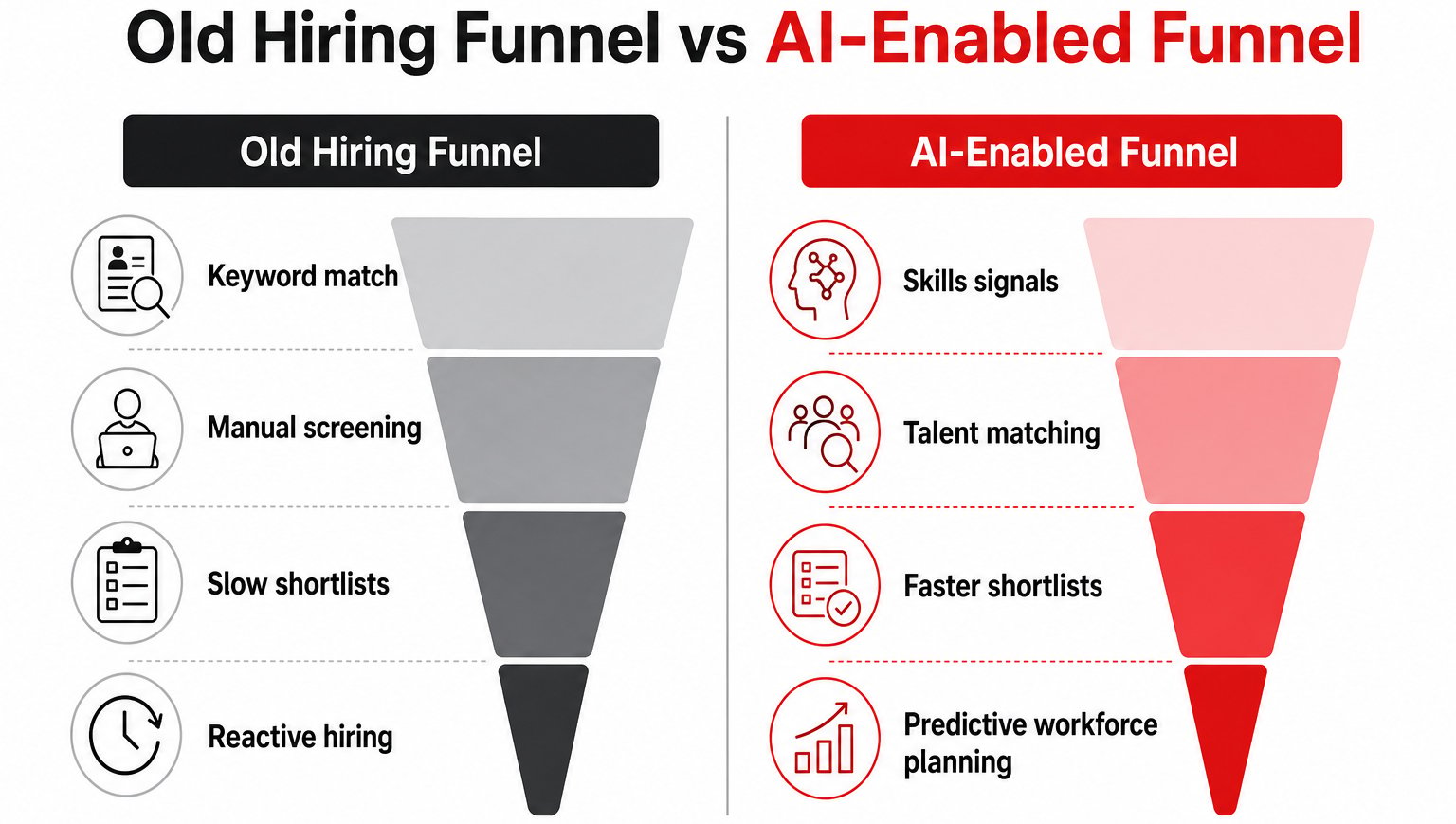 That approach is especially risky in IT staffing and specialized hiring. Strong candidates do not always describe their experience in the same language as a job posting. A developer may have transferable cloud experience without using the exact platform name. A project manager may have led complex digital transformation work without matching the title in the requisition.
AI can help hiring teams move toward skills-based hiring by looking at patterns, adjacent capabilities, and evidence of performance. Instead of asking only, “Has this person held this exact title?” the hiring process can ask:
- What problems has this person solved?
- Which skills are proven, current, and transferable?
- How close is the candidate to the required capability?
- What training or onboarding would close the gap?
- Is this person a better fit for another open role?
That is a better conversation for recruiters, hiring managers, and candidates.
Where AI Creates Real Hiring Value
The best use cases are practical. They remove friction from the hiring process without pretending judgment is unnecessary.
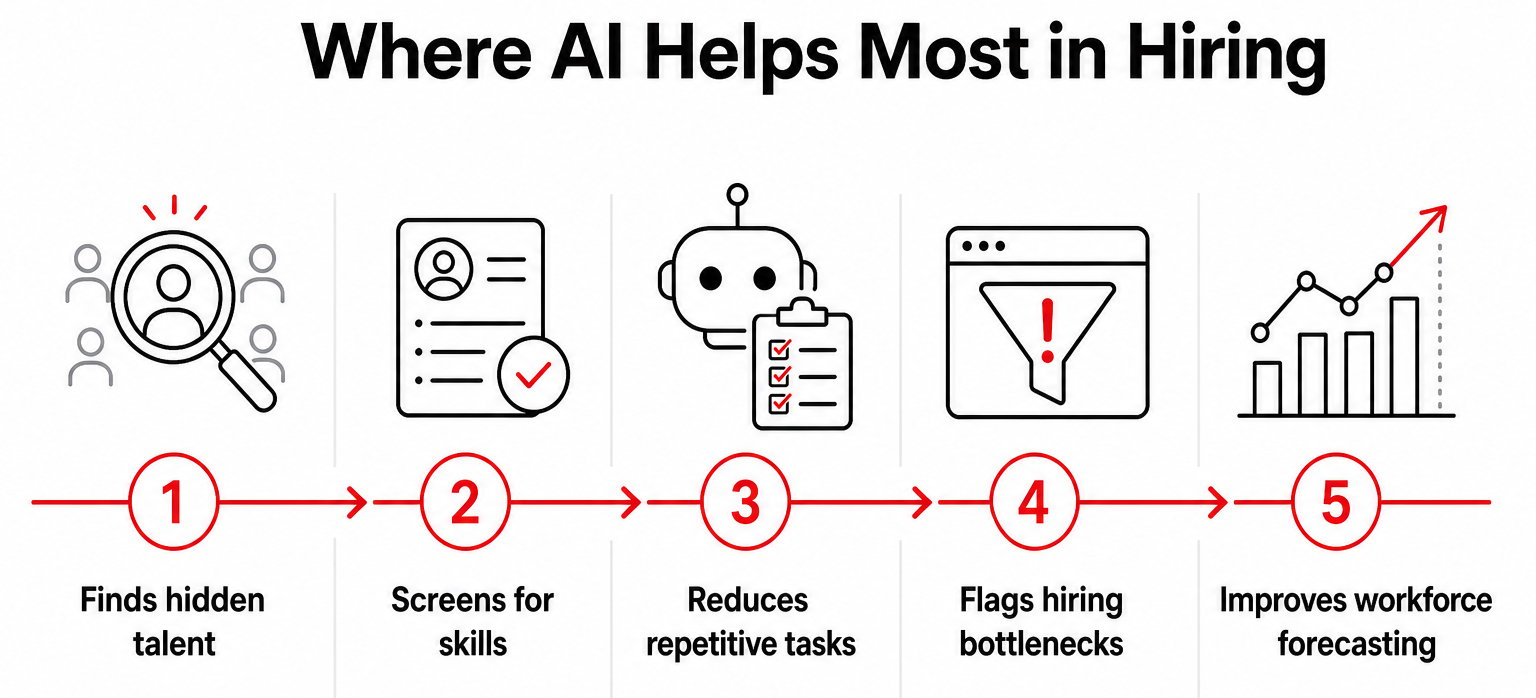
AI can help talent acquisition teams:
- Surface qualified candidates faster across large databases
- Identify passive talent that matches emerging skill needs
- Reduce repetitive screening and administrative work
- Compare candidate skills against role outcomes
- Spot bottlenecks in interview scheduling, feedback, and offer stages
- Support workforce planning with market and pipeline signals
- Improve consistency across high-volume hiring programs
For enterprise clients, the value is not just speed. Speed without quality creates rework. The deeper value is better alignment between business demand and available talent.
A staffing and workforce solutions partner can make this even more powerful by combining AI-enabled sourcing with human market knowledge. Technology may find the signal, but experienced recruiters know how to interpret it. They understand urgency, compensation reality, location constraints, client culture, and the difference between a candidate who looks good on paper and one who can succeed in the environment.
The Human-in-the-Loop Model Matters
AI should not be the final decision-maker in hiring. It should be the decision-support layer.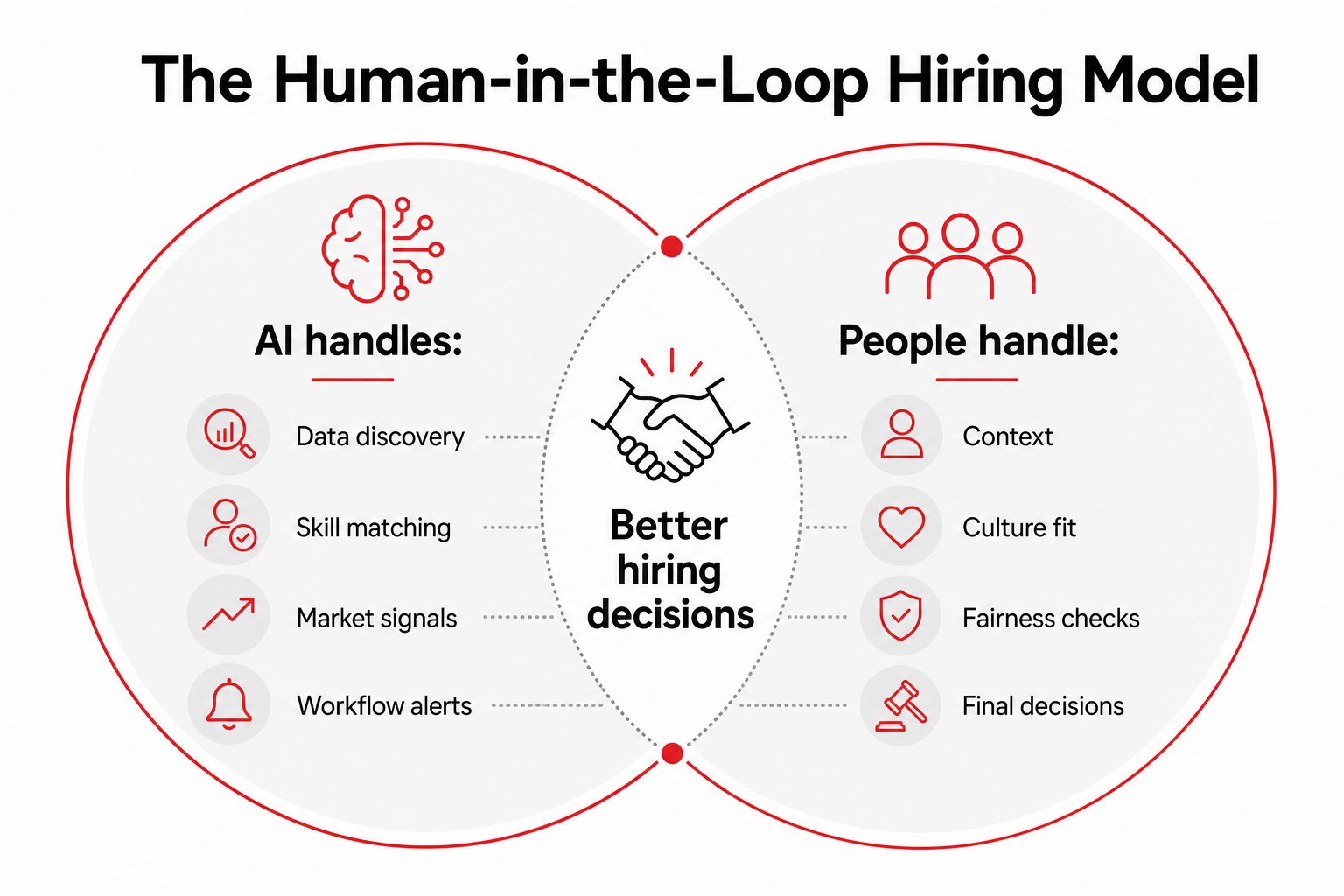 There are too many things a model cannot fully understand on its own: team dynamics, leadership style, client expectations, communication nuance, career motivation, and the context behind a resume gap or career pivot. These are human conversations.
A responsible AI hiring model keeps people involved at the moments that matter most. Recruiters and hiring managers should review recommendations, question assumptions, check for fairness, and validate fit through real interaction.
This is especially important for enterprise organizations with compliance obligations, diversity goals, and reputational risk. The more hiring teams rely on automation, the more they need governance. That includes clear criteria, bias review, auditability, data quality checks, and transparency about how tools are being used.
AI can make hiring more consistent, but only if the process around it is well designed.
What HR Leaders Should Look For in an AI-Enabled Staffing Partner
Not every provider using AI is delivering strategic value. Some are simply adding automation to old processes. HR leaders should look for partners who can explain how technology improves the hiring outcome, not just how it speeds up activity.
A strong partner should bring:
- Clear understanding of enterprise workforce goals
- Deep recruiting expertise across priority skill areas
- Transparent candidate evaluation methods
- Skills-based matching, not basic keyword filtering
- Human recruiter oversight at critical decision points
- Reporting that connects hiring activity to business outcomes
- Scalable delivery across locations, functions, and hiring models
For companies hiring across IT, professional services, healthcare, engineering, finance, or global delivery teams, this combination is critical. The market is moving too quickly for purely manual recruiting. But it is also too complex for fully automated hiring.
The winning model is both intelligent and human.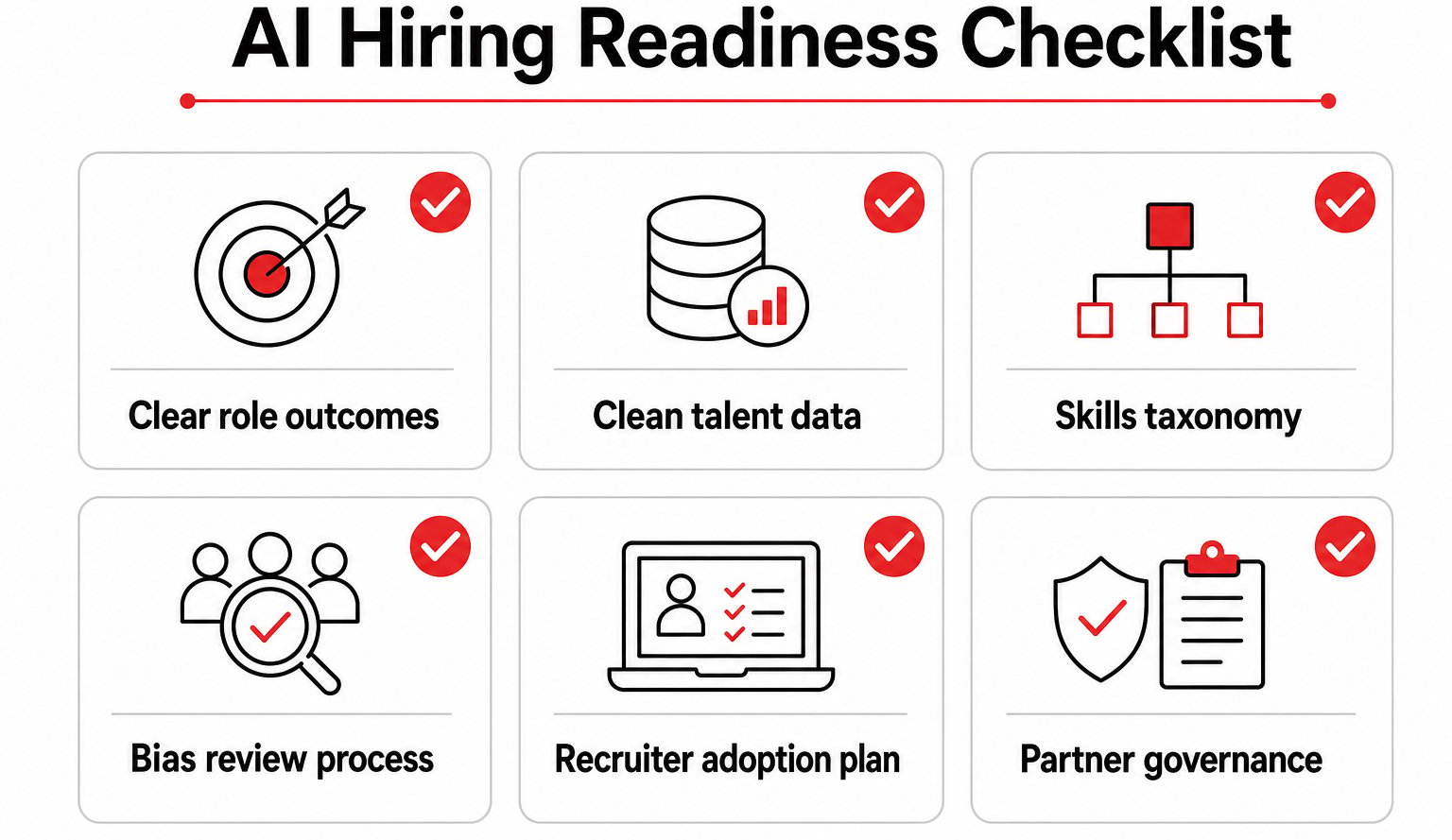
The Bottom Line
AI in talent acquisition is changing how enterprise hiring gets done, but it is not changing what great hiring requires. Companies still need clarity, trust, strong recruiter judgment, and a practical understanding of the labor market.
The difference is that hiring teams now have better tools to see what is happening sooner. They can find talent faster, understand skills more deeply, reduce process waste, and plan ahead with more confidence.
For HR leaders and enterprise clients, the takeaway is simple: do not adopt AI just to automate recruiting. Use it to build a smarter, more responsive talent acquisition strategy.
That is where AI creates lasting value. Not by removing the human edge, but by giving it better information to work with.
.png)