
A few years ago, global hiring sounded like an expansion strategy. Today, it feels more like a survival skill.
One enterprise HR leader recently described the problem in a blunt way: “The business wants specialized talent yesterday, finance wants predictability, legal wants zero surprises, and hiring managers still think the perfect candidate is waiting in one market.” That sentence captures the pressure many organizations are feeling.
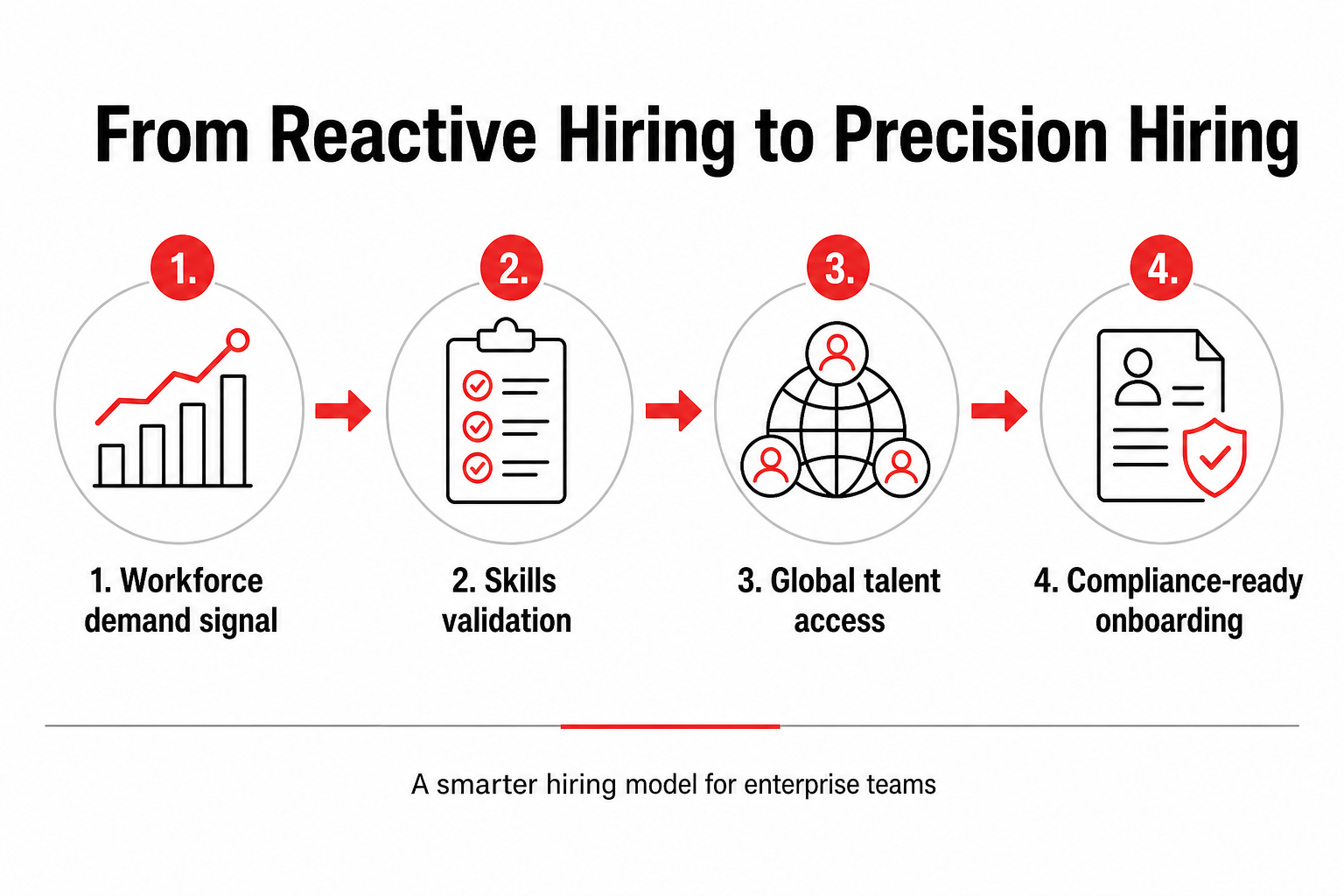 The workforce is moving faster than the systems built to manage it. AI skills are spreading beyond traditional technology teams. Compliance expectations are getting more complex. Hiring managers want speed, but boards want governance. At the same time, the best candidates may not live near headquarters, or even in the same country.
That is why a strong global hiring strategy is no longer just about opening roles in more locations. It is about building a smarter, more controlled way to access talent wherever the business needs it.
Why Global Hiring Has Become a Board-Level Issue
Global hiring used to sit mainly inside recruiting. Now it touches workforce planning, finance, procurement, legal, operations, and digital transformation. The World Economic Forum’s Future of Jobs Report 2025 points to a labor market being reshaped by technology, economic uncertainty, demographic shifts, and geo-economic fragmentation. Gartner has also reported that only 31% of recruiting teams use labor market data to inform talent strategy, even though recruiting is often the organization’s best window into external workforce change.
That gap matters.
If a company cannot see where skills are available, what they cost, how fast they can be hired, and what risks come with each market, hiring becomes reactive. Teams open roles late, chase the same limited pools, accept longer vacancy cycles, and lean on emergency contractors when project deadlines are already at risk.
A modern global hiring strategy gives leaders better answers to practical questions:
-
Which roles should be hired locally, nearshore, offshore, or remote?
-
Which skills are scarce enough to require a wider talent market?
-
Which countries create compliance or payroll complexity?
-
Which roles need contingent staffing, direct hire, RPO, or EOR/AOR support?
-
Which suppliers can actually deliver validated candidates at speed?
-
The goal is not to hire everywhere. The goal is to hire intelligently.
Speed Without Structure Creates Hidden Risk
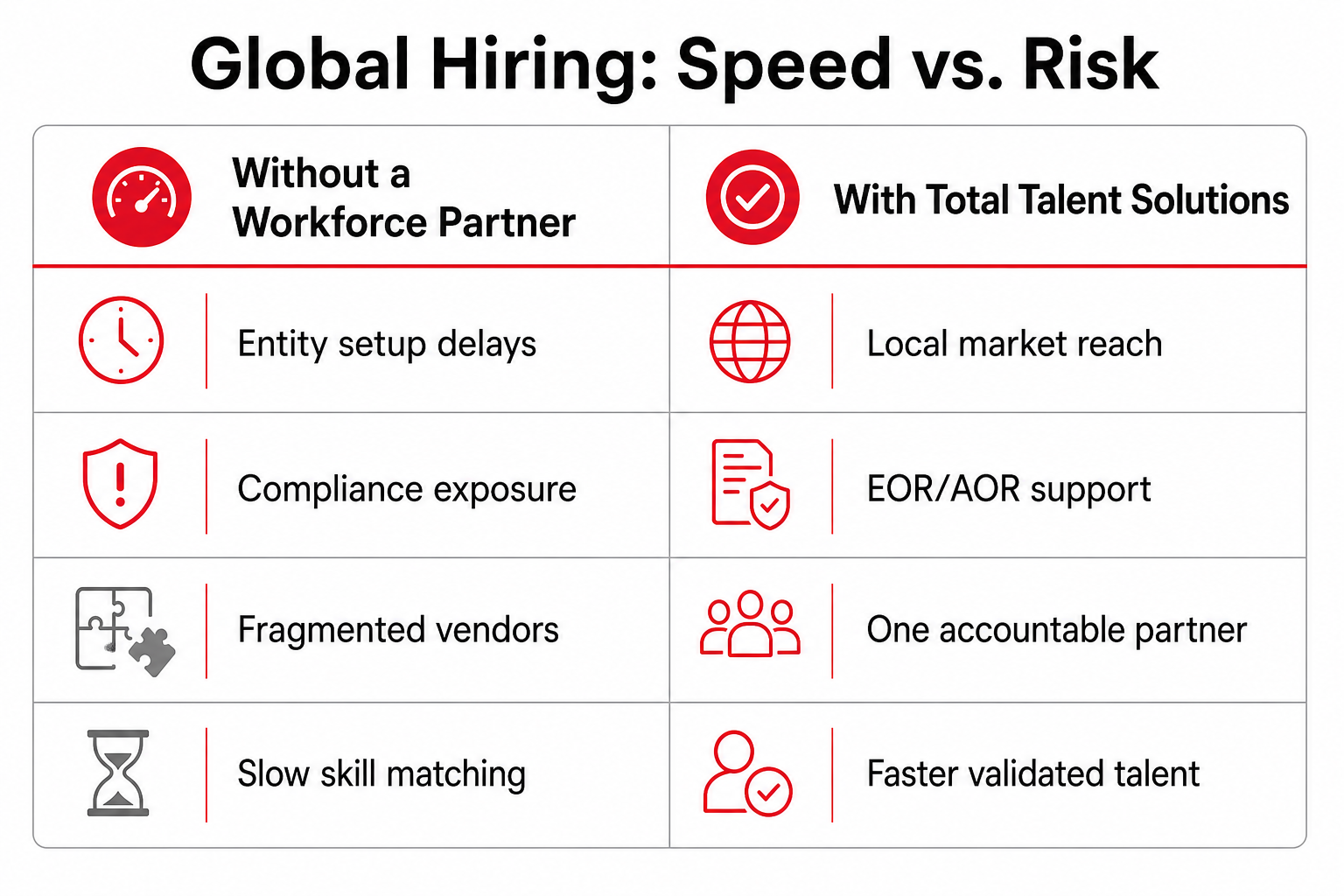 Enterprise hiring teams are under pressure to move quickly, especially in technology, engineering, healthcare, finance, and business operations. But speed without structure can create expensive problems.
A rushed global hire may look successful at first. The candidate starts, the team fills the gap, and the project moves forward. Then the hidden issues appear: misclassified worker status, unclear payroll ownership, weak background checks, inconsistent onboarding, poor contractor visibility, or local employment rules that were not fully reviewed.
This is where many companies confuse “access to candidates” with “workforce readiness.” A resume database is not a global hiring strategy. Neither is a long list of vendors.
What enterprises need is an operating model that balances speed, quality, and accountability. That usually means combining several workforce channels under one coordinated approach: contingent staffing for urgent project capacity, direct hire for long-term strategic roles, RPO for recruiting scale, and EOR/AOR or payroll support for compliant global engagement.
Net2Source’s positioning around total talent solutions is relevant here because the market is moving away from one-off hiring fixes. HR leaders want fewer fragmented handoffs and more connected workforce execution.
Skills Are Becoming the Real Hiring Currency
In 2026, job titles are less reliable than skills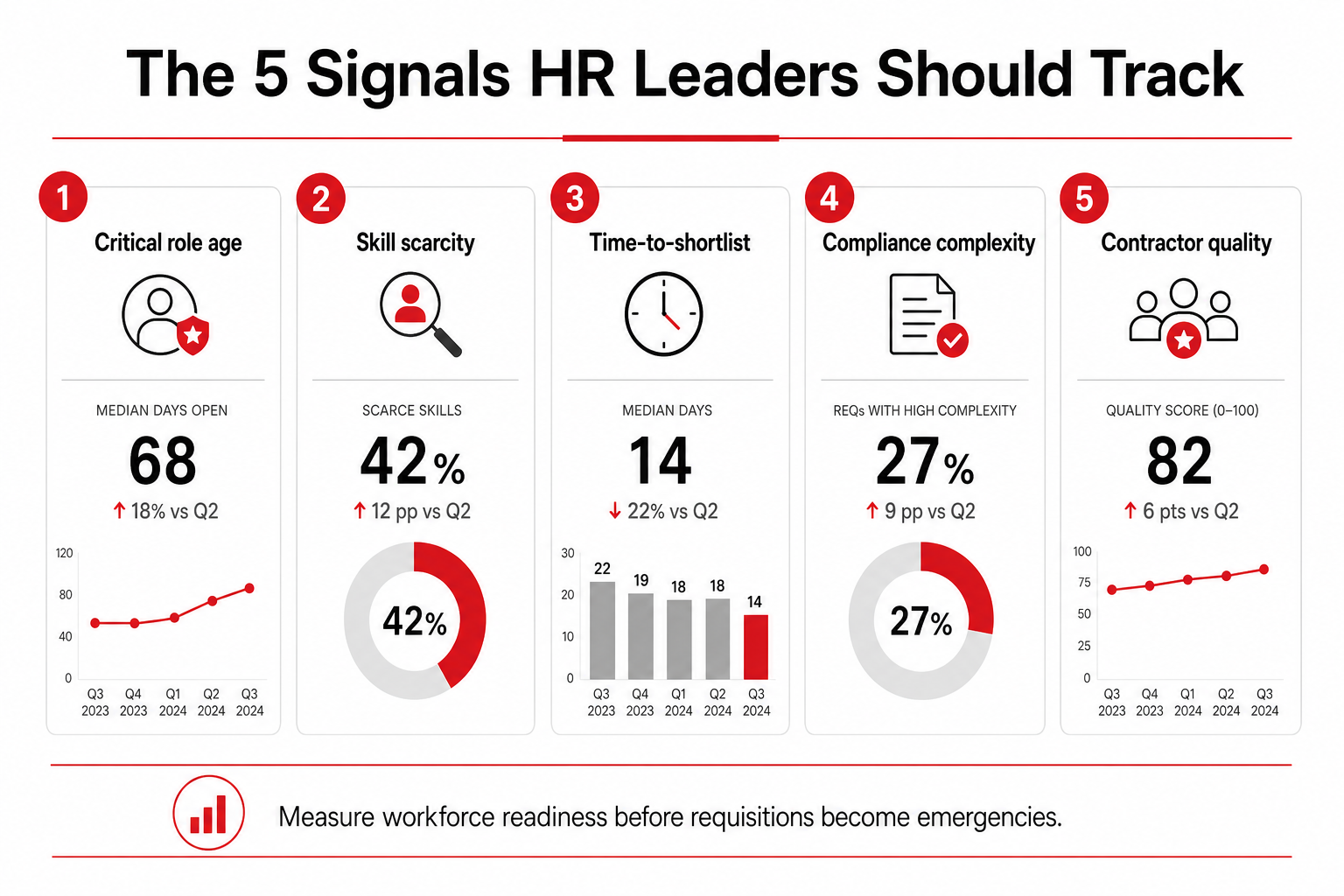 Two candidates may both be called “data engineer,” but one may specialize in cloud migration, another in real-time pipelines, and a third in AI model operations. The same pattern appears across cybersecurity, ERP, healthcare IT, finance transformation, and engineering roles.
This is why skills validation has become a core part of global talent acquisition. Enterprises do not simply need more applicants. They need candidates who have been screened for the right technical depth, domain fit, communication ability, availability, and work model.
A stronger global hiring strategy starts with mapping the work before opening the requisition. That means understanding:
-
The critical business outcome behind the role
-
The must-have skills versus trainable skills
-
The markets where those skills are realistically available
-
The employment model that best fits the work
-
The level of compliance review needed before onboarding
-
This approach gives HR leaders more influence. Instead of being asked to “fill a role,” they can advise the business on the fastest and safest route to capability.
The Case for a Total Talent Model
A total talent model helps enterprises stop treating every workforce need as a separate transaction.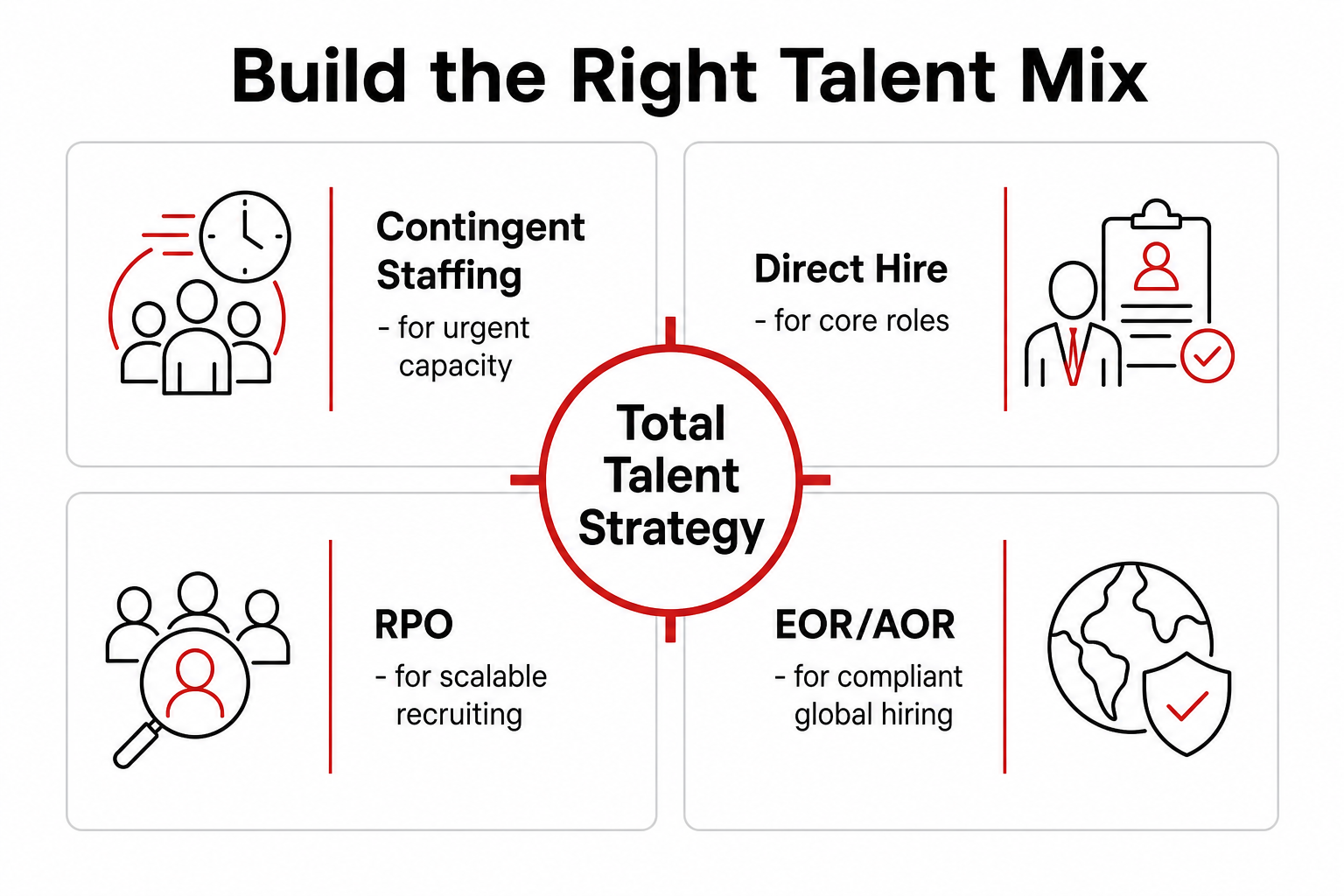 One team may need contract developers for a six-month implementation. Another may need permanent cybersecurity leaders. A third may need nearshore support for a managed service function. A fourth may need compliant payroll support in a country where the company has no entity.
If each team solves these needs independently, the organization ends up with scattered suppliers, uneven candidate quality, limited spend visibility, and inconsistent risk controls.
A total talent strategy brings these choices into one framework. It helps leaders decide when to use:
-
Contingent staffing for speed and flexible capacity
-
Direct hire for core roles and leadership continuity
-
RPO when recruiting volume needs to scale
-
Nearshore or co-shore models for cost-effective skilled delivery
-
EOR/AOR and payroll solutions for compliant global engagement
-
Statement of Work solutions when outcomes matter more than headcount
-
The benefit is not just operational efficiency. It gives enterprise leaders a clearer view of workforce supply, cost, risk, and performance.
What HR Leaders Should Do Next
The best time to improve a global hiring strategy is before the urgent requisition arrives.
Start with the roles that create the most business pain when left open. Look at time-to-fill, contractor quality, compliance complexity, supplier performance, and skill scarcity. Then identify which hiring needs are truly local and which could be solved through a wider global workforce model.
The next step is to simplify accountability. Too many enterprises have a supplier list but not a talent strategy. They know who can send resumes, but not who can help them make better workforce decisions.
A strong global staffing partner should bring market insight, vetted talent access, compliance awareness, delivery discipline, and flexibility across hiring models. That combination is what helps HR move from reactive recruiting to workforce readiness.
Global hiring in 2026 is not about chasing talent across borders. It is about building a workforce system that can adapt as business needs change. The companies that get this right will not just fill roles faster. They will make better decisions about where work gets done, how talent is engaged, and how risk is managed.
For HR leaders, that is the real opportunity: turn hiring from a pressure point into a strategic advantage.
.png)