

If you are thinking about starting a business in Dubai, one of the first questions that comes up is whether to go mainland or freezone. And honestly, this single decision shapes everything else, from where you can operate to how many visas you can apply for.
Both options are solid. Both are legal, well-regulated, and used by thousands of entrepreneurs every year. But they work differently, and choosing the wrong one can cost you time and money down the line.
Let us break it down in plain terms and help you make the right call for your business setup in Dubai.
What Is a Mainland Company in Dubai
A mainland company is registered with the Department of Economy and Tourism (DET) in Dubai. Once licensed, you can trade freely anywhere in the UAE, serve local customers directly, open branches in different emirates, and even bid for government contracts.
One big change in recent years is ownership. Previously, foreign investors needed a UAE national to hold 51% of their mainland company. That rule has been removed for over 1,000 commercial and industrial activities under Federal Decree-Law No. 26 of 2020. Today, most sectors allow 100% foreign ownership on the mainland. However, a small group of sectors classified as "Strategic Impact Activities", including defence, banking, telecommunications, and certain financial services, still require local participation or additional federal approvals. If your activity falls outside these, full foreign ownership on the mainland is now straightforward.
Mainland companies can operate from any location in the UAE, whether that is a retail shop in a mall, a corporate office in Business Bay, or a warehouse on the outskirts of the city. There is no geographic restriction on where you set up or where you serve customers.
What Is a Freezone Company in Dubai
A freezone is a special economic zone with its own rules and regulatory authority. There are over 40 freezones in the UAE, each catering to specific industries. DMCC is popular for trading and commodities, Dubai Internet City is focused on tech, JAFZA is ideal for logistics and manufacturing, and DIFC serves finance and fintech businesses.
Freezone companies have always allowed 100% foreign ownership, which was a major draw before mainland reforms. They also tend to have faster and simpler setup processes, with packages that bundle your license, visa allocation, and office space together.
However, freezone companies cannot trade directly with the UAE mainland market without going through a licensed local distributor or agent. If your business is purely export-focused, international, or digital in nature, this restriction may not matter much. But if your main customers are UAE residents or businesses, it can be a real limitation.
Key Differences Between Mainland and Freezone
Market Access
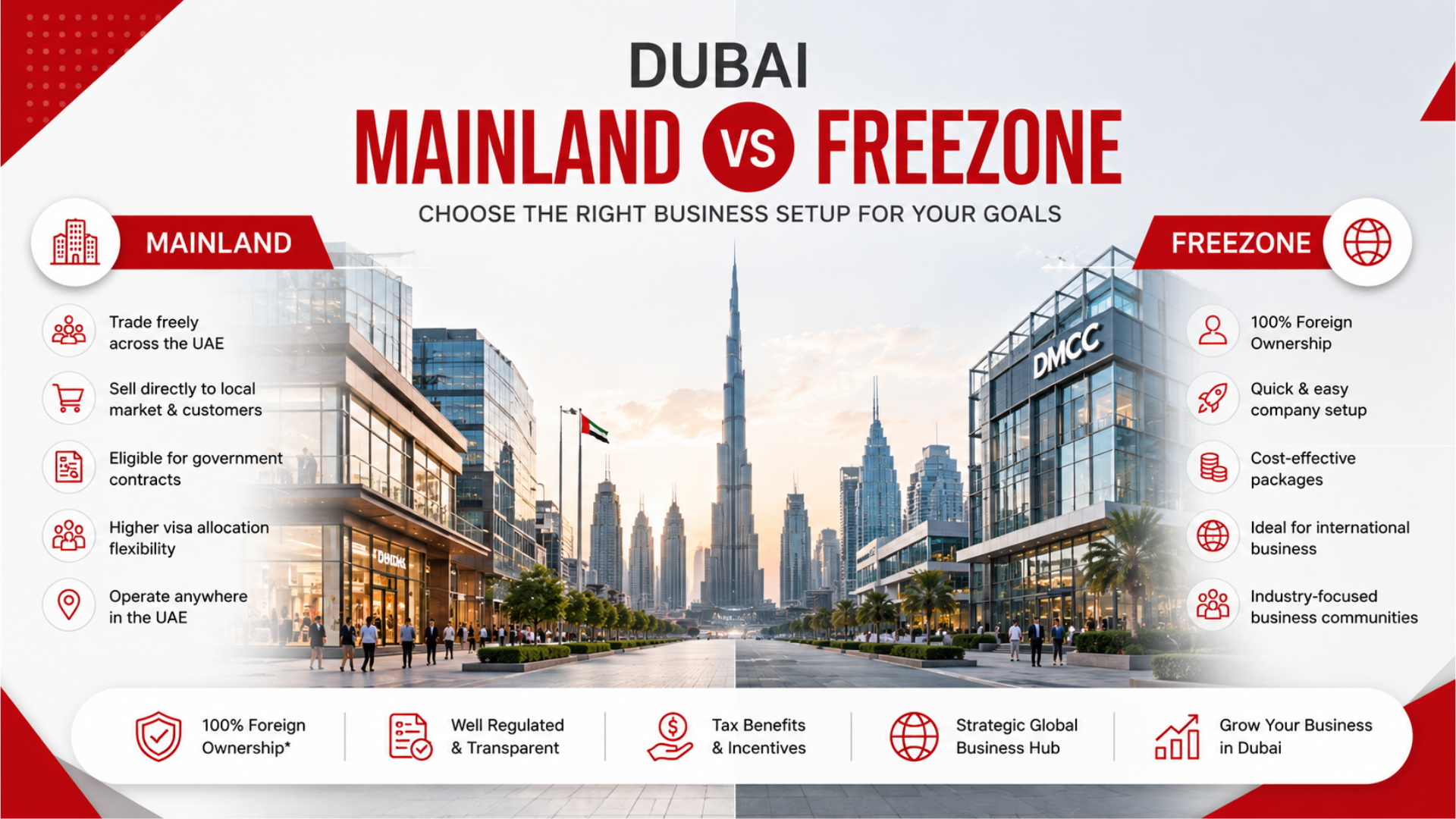
Mainland companies can sell directly to anyone in the UAE. Freezone companies are restricted to operating within their zone or internationally. To sell on the mainland, a freezone company needs a local distributor.
Ownership
Both now offer 100% foreign ownership for most activities. Freezone has always guaranteed this across the board, while mainland opened up ownership rights more recently under UAE Commercial Companies Law reforms.
Visa Allocation
Mainland companies typically have higher and more flexible visa quotas, tied to the size of your office. Freezone visa quotas are usually fixed by your license package, often ranging from one to six visas. If you are planning to build a large team, mainland may give you more flexibility.
Costs
Freezone setups are generally more affordable to start. Packages are structured and transparent. Mainland licenses involve office rental requirements and slightly more regulatory steps, which can increase initial costs.
Government Contracts
Only mainland companies can bid for government and semi-government projects. This alone is a deciding factor for many businesses in sectors like construction, healthcare, and IT services.
Regulatory Authority
Mainland companies are governed by the DET. Each freezone has its own independent authority, with its own rules and processes. This can be an advantage since freezone regulators are often faster and more streamlined.
Which One Should You Choose
There is no one-size-fits-all answer here. It depends on what your business does and who your customers are.
Go with mainland if you plan to run a retail shop or restaurant, offer services to UAE residents, bid for government contracts, or build a large team. It is also the right call if your business activity is not covered by any specific freezone.
Go with a freezone if you are running an export business, offering consultancy or digital services globally, or want a fast and cost-effective setup to start with. Freezones are especially good for solo founders and small teams that do not need wide local market access from day one.
Some entrepreneurs even set up both. A freezone entity handles international operations, and a mainland entity handles local trade.
So Which Path Makes More Sense for You
Dubai makes it relatively straightforward to set up a business, but only if you start with the right structure. Mainland gives you full access to the UAE market and more room to grow. Freezone gives you speed, simplicity, and lower startup costs.
Think about where your customers are, how big you plan to grow in the next two to three years, and what industry you are in. That should guide your decision more than anything else.
If you are unsure, talking to a business setup expert before you begin can save you a lot of back and forth later.
Frequently Asked Questions
Can a freezone company do business in Dubai mainland?
Not directly. A freezone company needs a licensed local distributor or agent to sell within the UAE mainland. Some freezones also offer dual license options.
Is 100% foreign ownership available on the mainland?
Yes, for most business activities. Reforms under the UAE Commercial Companies Law now allow full foreign ownership on the mainland for over 1,000 business activities. A few strategic sectors may still have special conditions.
Which is cheaper, mainland or freezone?
Freezone setups are usually more affordable upfront. But long-term costs depend on your visa needs, office requirements, and the market you are targeting.
Can I change from freezone to mainland later?
You cannot convert directly, but you can set up a separate mainland entity or branch while keeping your freezone license.